
Elbert County Court Records After Arrest
An Elbert County arrest can create a booking record, a bond record, a warrant record, and then a formal court case. The jail record is created when the person is processed at Elbert County Jail. The court record begins when a charging document, case entry, warrant proceeding, bond matter, accusation, indictment, plea, dismissal, or final disposition is filed in the correct court.
The Elbert County jail inmate records page is the right source for custody status and roster fields. The court side is handled through the Elbert County Clerk of Court for Superior, State, and Juvenile Courts, through Magistrate Court for warrants, committal hearings, and many bond matters, and through the Northern Judicial Circuit District Attorney when charges are prosecuted.
Elbert County Court Records Access
The Georgia Courts e-access page lists Elbert State and Elbert Superior among courts that route users to provider access. The research found that the provider path points toward PeachCourt-style access rather than a no-login county docket. PeachCourt presents register and login options for civil and criminal eFiling and court documents.
- Use the jail roster first to identify the booking date, charge wording, bond, and court field if available.
- Check Georgia Courts e-access for Elbert State or Elbert Superior provider access.
- Use a PeachCourt account path when provider access is required.
- Contact the Elbert Clerk of Court for certified copies, older records, and records not clear from provider access.
- Contact Magistrate Court for warrant, committal-hearing, and magistrate bond questions.
The Georgia Courts e-access screenshot shows the statewide access point that lists Elbert court providers.
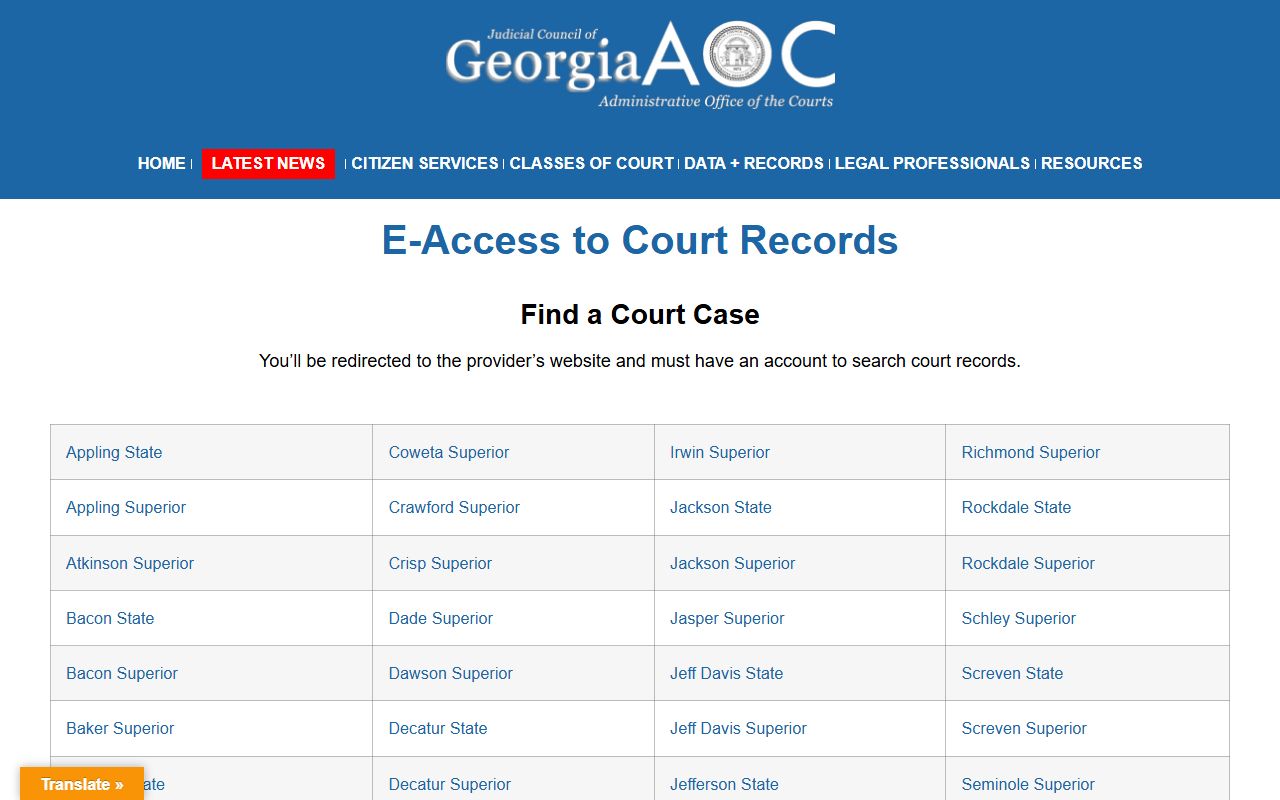
Provider access is not the same as the jail roster. It is used for court records after the arrest has moved into a court case.
Elbert Clerk Court Records
The Elbert County Clerk of Court records proceedings for Superior, State, and Juvenile Courts. The Clerk is Leigh W. Starrett. The office is at 12 South Oliver Street, P.O. Box 619, Elberton, GA 30635, with phone 706-283-2005 and fax 706-213-7286. This office is the local contact for many court records after a jail arrest, especially when a document, certified copy, or older record is needed.
| Office or Portal | Access | Use It For |
|---|---|---|
| Georgia Courts e-access | County/court provider links | Elbert State and Superior provider path. |
| PeachCourt | Registration and login | Civil and criminal eFiling and documents. |
| Elbert Clerk of Court | Phone, mail, in person | Superior, State, and Juvenile Court records. |
| Magistrate Court | Phone or in person | Warrants, committal hearings, bond authority. |
Charges Filed After Arrest
Charges can change between jail booking and court filing. A roster charge may be based on the arresting agency's booking information. The prosecutor then reviews the case and may file, amend, reduce, dismiss, or seek indictment on different wording. Court records after an arrest should be read with that sequence in mind.
| Document | Who Uses It | Plain Meaning |
|---|---|---|
| Complaint | Officer or prosecutor | Initial sworn accusation or charging basis. |
| Accusation / Information | Prosecutor | Formal charge filed without grand-jury indictment where allowed. |
| Indictment | Grand jury | Grand-jury charging document for felony prosecution. |
Elbert County Prosecutor Records
Elbert County is part of the Northern Judicial Circuit District Attorney's Office, which serves Elbert, Franklin, Hart, Madison, and Oglethorpe Counties. The DA homepage names D. Parks White as District Attorney. The Elbert County DA office lists Assistant District Attorney Charles Rettiger and Office Manager Denise Bird, with a physical office at 45 Forest Avenue and a mailing address of P.O. Box 247, Elberton, GA 30635.
The DA contact page states that defendants or family members of defendants, other than victims, must contact their attorney because the DA's Office cannot speak directly with them. It also provides a public defender number of 706-246-9320. DA open-records requests route to Hope Cobb, Chief Investigator, at the Hartwell mailing address listed by the office.
Elbert County Charge Status
Charge status is one of the main reasons to search court records after a jail arrest. A charge can remain pending, be amended, be reduced, be dismissed, be nolle prossed, end in a plea, or go to trial. A booking record does not prove conviction, and a court record may show a different status from the roster entry.
| Status | What It Means |
|---|---|
| Pending | The charge is open and has not reached final disposition. |
| Amended or reduced | The charge wording, level, or count changed after review. |
| Dismissed | The court record no longer moves forward on that charge. |
| Nolle prosequi | The prosecutor declined to proceed on that charge. |
| Convicted | A guilty plea, verdict, or other conviction disposition was entered. |
Bond After Elbert Arrest
The Sheriff's divisions page says the jail may give a person an opportunity to post cash or property bond and be released pending court, or hold the person until court disposition. The Magistrate Court page says the chief magistrate sets bonds on criminal charges except charges carrying death penalty or life in prison. Statewide Georgia materials add that misdemeanor initial appearance timing is no later than 48 hours after a warrantless misdemeanor arrest or 72 hours after arrest on a warrant.
| Bond Type | Local Context |
|---|---|
| Cash bond | Named by the Sheriff's Office as an available release route when allowed. |
| Property bond | Also named by the Sheriff's Office. |
| Commercial surety | Listed in statewide materials, but no Elbert approved-company list was found. |
| Recognizance | Listed in statewide materials; local use depends on the court order. |
| No-bond hold | Can keep a person in custody even when the roster shows other case details. |
Warrants Before Jail Arrest
No official Elbert County online active-warrant search was found in the research. The Sheriff's Patrol Division serves warrants, and Magistrate Court has the clearest local warrant role. The chief magistrate issues criminal warrants for the public and law enforcement, search warrants, fugitive warrants, and waivers of extradition. Georgia.gov says warrant checks are county-specific and typically route through the sheriff's office.
If a warrant has already led to jail booking, the roster's charge tab may show warrant number, charge description, type, statute, count, and court. If the person is not on the roster, they may have been released, moved, booked elsewhere, or not yet booked locally.
Charges and Convictions Compared
The difference between a charge and a conviction is central to court records after a jail arrest. A charge is an accusation filed or carried forward in court. A conviction is a legal outcome after a plea, verdict, or other adjudication. Public records can show both, but they do not mean the same thing.
| Point | Charge | Conviction |
|---|---|---|
| Stage | Accusation or filed count | Final guilty outcome |
| Proof | Not proof of guilt | Entered after plea, verdict, or legal finding |
| Can change | May be amended, dropped, or reduced | May later be appealed, restricted, or otherwise affected by law |
Restricted Elbert Arrest Records
Georgia uses the term record restriction for many arrest-cycle access limits. The GBI record restriction page cites O.C.G.A. 35-3-37 and explains the process for eligible records. Arrests after July 1, 2013 generally require contact with the prosecutor. Older arrests use an application process through the arresting agency.
| Term | Georgia Context | Effect |
|---|---|---|
| Restricted | Georgia's common term for limiting eligible criminal-history access | Limits non-criminal-justice dissemination when approved. |
| Sealed | Often used generally for records hidden from public access | May not erase every government record. |
| Expunged | Common public term, but Georgia commonly describes restriction | Eligibility depends on statute and case outcome. |
Using Court Records Carefully
Court records after a jail arrest can show public case history, but they should not be used as a substitute for a court-certified record, attorney advice, or an FCRA-compliant background check. Georgia Open Records Act rules permit access to many public records, while exemptions and redactions may protect personal, medical, juvenile, law-enforcement, or other sensitive information.
Important: Verify custody, charges, and disposition with the Clerk, court, sheriff, or prosecutor before relying on a record.
Public Record Search
Sponsored Results